
Search for answers or browse our knowledge base.
Ghor
Ghor
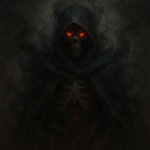
The god of Chaos: Ghor
Bringer of Corruption, The Red-Eyed God
“When shadows linger and fear takes root, beware the touch of Ghor.” — old warning
Ghor is the Old God of chaos and corruption. Its presence is feared across Eonil, for it is said to dwell in the hidden places where light cannot reach. Many believe that misfortune, sickness and monstrous mutations are the work of Ghor’s lingering malice.
Ghor is neither man nor woman; it is simply chaos and corruption made manifest. Most people refer to Ghor as it, sometimes as they when speaking carefully.
Quick Facts
-
Type: Old God
-
Domains: Chaos, corruption, decay, madness, monstrous transformation, fear
-
Celestial body: The red moon Ghor (the blood moon)
-
Pronouns: It / its (sometimes they / them)
-
Titles: Bringer of Corruption, The Red-Eyed God, Lord of Shadows
-
Symbols: Red moon, burning eyes in darkness, creeping rot
-
Colours: Red, black, dark brown
-
Associations (feared): Decay, madness, monstrous beasts, misfortune
Symbols and Appearance
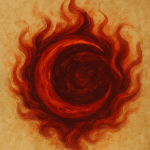
The Symbol of Ghor
Symbols
Ghor’s signs and omens include:
-
The red moon rising in the sky
-
A shadow with glowing eyes
-
The sudden stench of rot in a place that should be clean
People avoid painting or carving its likeness, fearing it may draw Ghor’s attention. In rare cases, cursed objects or places believed to be marked by Ghor are abandoned or ritually cleansed by temple priestesses.
Appearance
Because most cultures fear to depict Ghor directly, there is no single agreed form. In stories and rough carvings it is hinted at as:
-
A shape of shifting shadow with burning red eyes
-
A swirling mass of smoke and flame, like a piece of the blood moon fallen to earth
-
A distorted figure whose features cannot be clearly remembered after the dream or nightmare ends
Whatever the form, Ghor is always connected to corruption, fear and loss of control.
Ghor in the Fifth Era
In the present Fifth Era, Ghor is officially declared “dead” by the New Faiths, together with Quintra and Denday. In practice, people still blame Ghor for anything that feels cursed or wrong.
Followers of the Old Gods are hunted, and any open worship of Ghor is unthinkable in most lands. Instead, there are whispered rumours of secret cults, blood altars in forgotten ruins and individuals who willingly seek Ghor’s favour in exchange for power, revenge or survival.
Most common folk try not to speak Ghor’s name at all, believing that even naming the god might draw its eye.
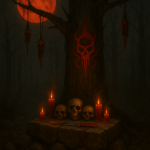
Ghor Altar
Worship and Cults
There are no public temples to Ghor. Instead there are:
-
Cautionary tales told to children around the fire, warning them not to wander at dusk or linger near ruins.
-
Rumours of hidden altars where blood or foul offerings are left in return for curses and twisted blessings.
-
Village protective rites at the turning of the seasons, where priests of other gods pray specifically to keep Ghor’s influence away.
Where Quintra and Denday once had open, organised churches, Ghor’s “worship” survives mostly as fear, avoidance and taboo, with only scattered and secret cults actively seeking the god’s favour.
Magic and the Nature of Corruption
Where Quintra brings healing and Denday weaves dreams and guidance, Ghor is blamed for decay and ruin.
People often attribute to Ghor:
-
Rot in crops and blights that spread unnaturally fast
-
Sudden, wasting sickness or violent madness
-
The bite or venom of twisted creatures
-
Mutations and monstrous changes in both animals and people
In some stories, those who stray too far from the light, or who willingly bargain with Ghor, lose themselves, becoming twisted in body or spirit. Unlike the darker forms of magic linked to Quintra or Denday, Ghor’s corruption is commonly believed to never fully cleanse: once something truly belongs to Ghor, it is changed forever.
At the turning of seasons and during strange omens, lanterns are left burning and prayers of protection are offered, not to Ghor, but against it.
Fear and Folklore
Ghor is seldom spoken of openly. Old tales warn children not to:
-
Wander into forests at dusk
-
Explore caves, ruins or abandoned temples after dark
-
Travel alone when the red moon is high
It is said that when the red moon rises alongside or after Denday’s blue moon, Ghor’s watchful eye is upon the world. Villages report strange happenings at such times: livestock panicking, nightmares spreading through households, tempers flaring into sudden violence.
Some claim to have seen beasts changed by Ghor’s influence — creatures with burning eyes, twisted limbs or smoke rising from their fur, filled with unnatural rage. Whether or not the tales are true, few are willing to test them.
Myth & History
Dawn and the Rule of Chaos
At the dawn of time, Ghor ruled Eonil through chaos and cruelty. When Eonil herself turned against it, Ghor cast her into the heart of the world, turning the gentle goddess into the planet itself.
Ghor then unleashed endless darkness over the surface, twisting all life to its will. For ages, only monsters and corruption walked the world, and all peace was driven away.
Defeat and Banishment
The coming of the Twin Goddesses Quintra and Denday was the first true challenge to Ghor’s power. Together, the light of the sun and the glow of the blue moon pushed back its chaos. After a long war they defeated Ghor and banished it to the red moon that still circles Eonil.
From that time onward the red moon itself became a symbol of Ghor’s imprisonment and enduring threat. Even in victory, the twins could not fully erase Ghor’s touch from the world.
Age of Darkness and Beyond
When Quintra and Denday were later banished to their own celestial bodies, their blessings weakened. Over the centuries that followed — the Age of Darkness — Ghor’s influence crept back into the world through war, plague, undead and monstrous corruption.
By the time the New Faiths arrived and declared the Old Gods dead, fear of Ghor was already deeply rooted. The Church hunts followers of the Old Gods, but where Quintra and Denday are remembered with a mix of longing and nostalgia, Ghor is remembered mainly as a warning of what true chaos can do if unchallenged.
On the Night
While the night belongs to Denday, it is in the deepest, most starless hours that Ghor’s power is said to be strongest. Travellers hurry home before moonset, and only a fool challenges the dark alone when the red moon is in the sky.
Most protective sayings and charms end with some variation of:
“May your lantern burn bright, and keep the shadow of Ghor far from your door.”