
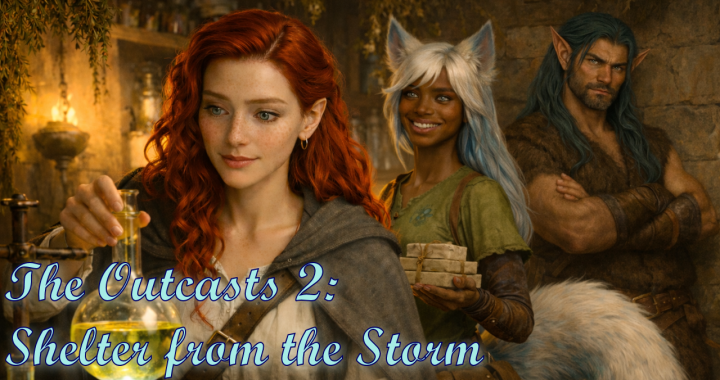
Darkness pressed in. Suraia was running—through endless alleyways, rain pelting her face, boots splashing through muddy puddles. Shadows pressed close, warped by memory and fear.
“Heretic!”
“Witch! Her hands—did you see them glow?”
“Keep her away from my child!”
Faces swirled, half-seen in the downpour, their eyes bright with suspicion and something colder—disgust. The red headed woman wrapped her cloak tighter, shrinking into herself, as if she could contain the magic in her veins—hide the faint, traitorous flicker of white-blue light at her fingertips. Somewhere behind her, a hand seized her shoulder—rough, insistent, demanding. She spun away, breathless and desperate, stumbling into the next street, only to find a door, a promise of safety—slammed in her face.
The storm drove needles into her scalp. She stood for a moment, drenched and shivering, the world spinning around her, her heart thudding against her ribs. In her palm, her magic shimmered uncontrollably, not gold as it once had been, but white with a soft blue hue—something different. Something people feared.
“You shouldn’t be here. We don’t want your kind.”
She tried to answer, to explain, but her voice was lost—swallowed by the cold, relentless rain.
Suraia woke with a sharp gasp, heart pounding, fingers curled in the worn fabric of her blanket. The phantom sting of rain lingered on her skin. For a moment she did not know where she was. Her mind clawed its way back from memory to reality: the small cave, the steady drip of water outside, the faint scent of smoke and wet earth.
The storm’s low growl echoed in the distance. Shadows danced along the cave walls, thrown by the tiny, flickering fire. The air was cool and damp, smelling of moss, stone, and faintly of salt. The cave felt vast and ancient, its corners lost in gloom, ceiling low where she slept, higher by the mouth where a large, muscular elven man sat—an unmoving sentinel outlined by grey daylight.
He seemed a part of the stone itself, massive and motionless, his silhouette sharp-edged against the sky. His back was to her, head bent in silent vigil, rain blurring the view beyond.
She shivered, drawing a rough fur pelt that seemed to function as a blanket closer. Her dress, still torn and mud-caked from the wreck, clung damply to her skin. She wore only one boot—the other, a casualty of panic and the woods. Her healer’s pouch was a sorry thing now: a few linen scraps, a battered vial of salve, some crushed, sodden herbs she’d brewed into a bitter tea in a failed attempt to keep her nightmares at bay.
Days drifted by in a fog of exhaustion and feverish dreams. She had no idea who her elven guardian was, only that he hadn’t hurt her. She could only assume he had found her and brought her here.
Suraia slipped between uneasy sleep and waking, her body battered, her spirit raw. At night, the nightmares returned—shouted slurs, slamming doors, faces twisted by hatred. She woke more than once with a cry stifled against her fist, the taste of tears on her lips.
Sometimes, in her delirium, she saw those faces in the shadows, their eyes following her from the cave’s dim recesses. She tried to remind herself that she was far from any village now, far from the accusing words and fearful glances that haunted her. But loneliness pressed in—almost as heavy as the memories themselves.
It was not until one night, she didn’t know how many days had passed, that the massive elf, silent and awkward, shifted a little closer to where she lay. His warmth radiated like a hearth in the cold, damp world. She dared not move at first, but as the night deepened, she found herself pressed against his side, breathing easier, the dreams fading into gentler shadows. Neither of them spoke of it.
Sometimes she wondered if he slept at all. In the deepest hours of the night, she would glance over and see his eyes—reflecting the faint glow of the fire, unblinking, distant. There was something otherworldly about him, as if the wild itself had shaped him from root and stone.
In the waking hours, Suraia tended her wounds as best she could. Cuts on her hands, bruises on her shins, the deep ache in her side—all were cleaned and bound with precious scraps of cloth and the last of her salve. Sometimes she glanced at the elf’s injuries—scratches and the angry red bite on his shoulder—but dared not ask to help. In her weakened state she could offer nothing, and he seemed to need nothing.
Each morning, the Ee’dornil was already awake, returning from some errand in the storm. His words were always sparse, his voice low and gravelly.
“Stay put. You will get lost and die if you wander. I will return before dusk.”
He would disappear into the rain, his figure dissolving among the wind-bent trees. Suraia listened for him, the silence of the cave pressing close, doubts gnawing in her mind. Who was he, really, this guardian of the wilds? Why had he saved her? And what did he plan to do when the storm passed?
With no answer, she let her gaze wander the cavern’s nooks and crevices. Strange marks—some old, some newer—were scratched into the stone above the fire. She traced them with her gaze, wondering if they were druidic runes, warding spells, or just the idle art of loneliness. Occasionally, an animal skull or a twisted feather caught the firelight, hinting at a world of rituals and stories she could only guess at.
Out in the forest, Thorn prowled with restless energy, the storm lashing at his face and hair. He preferred the wild solitude, far from the cave and its burden of awkward gratitude. Among the battered driftwood and salt-stiff grass of the shoreline, he felt something close to peace. He scanned the tideline, scavenging what the shipwreck had surrendered: a battered lifeboat, mostly intact but wedged among rocks and seaweed; crates—splintered, half-buried, but promising. Within them, he unearthed a faded, oversized cloak, a pair of boots, some salt-rusted crates with dried meat. He packed only what the human woman would need, leaving the rest near the boat.
He would not tell her about the boat—not yet. The storm was still a living thing, the sea a promise of death for the unwise. When the time was right, he would force her from his island, back to the world she had come from. It was too great a risk to fly, so they would have to go through the water.
The human was a complication—a frail, shivering reminder of oaths he had sworn long ago, oaths that would not let him turn his back on the helpless.
He always returned soaked, his hair plastered to his face, his hands scratched and raw. He set new finds silently beside Suraia: a heavy cloak, boots that dwarfed her feet, a few wild berries or twisted roots that she boiled into thin tea. He spoke little and she learned not to ask. He seemed to prefer the company of wind and rain.
At night, when he returned and thought her sleeping, Thorn would watch her for long moments. There was something in the set of her jaw, the way she clung to hope even as her dreams battered her. He recognised that stubbornness; it was what had kept him alive, too, all these lonely years.
The next day the rain was still going strong. Outside the cave, the world was grey and blurred, the forest swallowed by a curtain of water and mist. Thorn had gone out again, leaving Suraia with stern instructions not to wander. The small fire flickered at her side, offering some comfort, but the emptiness pressed in on her.
She drew the oversized cloak tighter, scooting closer to the cave’s entrance. She peered out into the rain, watching as droplets slid down moss and stone. Somewhere out there, the sea crashed against the rocks, unseen but ever-present.
Her mind drifted to the dire wolf—the great, green-furred beast who had saved her life on the edge of the forest. She remembered the way he had appeared, silent and sudden, driving off her attacker and then, injured, circling her warily. She remembered how she had healed him, how exhaustion had claimed her before she could see what happened next.
When she woke, it was not the wolf who watched over her, but the Ee’dornil man. He had been brusque and distant, tending the fire, saying little. She had looked for signs of the wolf—a tuft of fur, tracks in the mud—but there had been nothing. No howls in the night, no glowing green eyes at the edge of the firelight.
Did the elven man know the wolf? Had the beast brought him to her? Or… had the wolf wandered away into the endless rain, still wounded, perhaps never to return? She worried for the creature’s safety, feeling a pang of guilt that she could not do more, could not even be sure if her magic had truly healed him.
Sometimes, she fancied she could hear distant howls between thunderclaps, but when she strained to listen, there was only the ceaseless patter of rain or the soft footsteps of the Ee’dornil.
The cave felt lonelier in the Ee’dornil’s absence, and Suraia’s thoughts circled round and round the same questions. She wished she could thank the wolf or at least know he was all right. Perhaps, when the storm ended, she would see him again. Perhaps her blunt guardian would know where to look.
But for now, there was only rain, and the silent hope that somewhere out in the wild, her mysterious saviour still roamed.
As the days crept by, Suraia’s strength returned, but so did her anxiety. Gratitude tangled with uncertainty. She wanted to thank the elven man, to know more about her strange, gruff benefactor, but conversation felt like climbing a cliff in the dark.
Sometimes she rehearsed questions in her head—his name, where they were, what would happen next. Always, she lost her nerve. He seemed to carry an invisible wall with him; a barrier built of ancient wounds and wild loneliness.
On the fourth day, as thunder faded and rain softened to mist, she forced herself to speak.
She fumbled with the edge of her sleeve, voice trembling:
“My name is Suraia… Suraia Silverbell. Thank you for… helping me sir… um, Master Ee’dornil… sir?”
Thorn turned, his brows knit in a scowl. His answer was abrupt, almost brusque:
“Do not call me sir. Or master. Thorn will do.”
Suraia blinked, abashed, clearly the conversation was over as he turned back to the world beyond the cave.
She sat in silence for a while, then, feeling foolish, tried again the next evening as she shared a bowl of thin stew. “Did… did you always live here? Is this... Eedrasil’s Rest?”
He glanced her way, measuring her with his moss-bright eyes. “Long enough.”
It was more than he had given her before, and though no more words came, Suraia found herself warmed by that single admission.
The days blurred storm and silence, the sound of rain and fire, the comfort of Thorn’s quiet presence. Suraia tried to help tidying the cave, mending her battered dress, boiling roots into bland meals. Small things, they made the cave feel less like a tomb, more like a shelter. She slept better now, pressed to Thorn’s side as if it were the most natural thing in the world.
When the storm finally broke—a strand of sunlight piercing the clouds in the morning—Suraia sat by the dying fire, cloak drawn close, her blue eyes lingering on Thorn.
He stood, stretching his long limbs, something new—resolve, or perhaps just relief—settling over him.
He turned to her at last, the mask of gruffness slipping, just a little.
“Rest today. Tomorrow, we move. I will get you back to your people.”
Suraia nodded, lips pressed in a thin line, dread coiling in her stomach.
Back to her people. The words echoed, hollow. Who was left to welcome her? Who among them would look past the colour of her magic and not see a heretic, an outcast? The old pain pressed close, memories of closed doors and averted eyes.
She forced a small smile for Thorn’s sake, letting silence fall between them. He could return her to civilisation, but not to belonging. That was something neither of them could give.