
Search for answers or browse our knowledge base.
Denday
0 out of 5 stars
| 5 Stars | 0% | |
| 4 Stars | 0% | |
| 3 Stars | 0% | |
| 2 Stars | 0% | |
| 1 Stars | 0% |
Denday
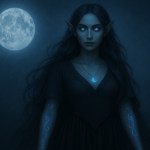
The goddess of Dark: Denday
Lady of the Blue Moon, Mistress of Night
“When Denday’s blue light rises, the world holds its breath.” — Fireside saying
Denday is the Old Goddess of the blue moon and the night. Her presence is felt whenever darkness falls and the soft blue moon climbs the sky. She is the silent watcher of forests and shadows, guardian of dreams, secrets and the unseen paths of the world.
Denday is the twin sister of Quintra, goddess of Light, and one of the three Old Gods alongside Quintra and Ghor. She is always regarded as female and referred to with she / her pronouns.
Quick Facts
-
Type: Old God
-
Domains: Night, blue moon, shadows, wild places, dreams, secrets, guidance in darkness
-
Celestial body: The blue moon Denday
-
Pronouns: She / her
-
Titles: Lady of the Blue Moon, Mistress of Night, The Silent Watcher
-
Symbols: Blue moon (crescent or full), blue drop of water, blue feather or stone
-
Colours: Blue, silver, indigo
-
Gifts (traditional): Mystery, guidance, protection in darkness, dreams
Symbols and Appearance

The Symbol of Denday
Symbols
Denday’s symbols include:
-
The crescent or full blue moon
-
A silver-blue drop of water
-
A single blue feather or stone
On rare nights when the blue moon is full, stories are told by firelight and those who are brave or curious may walk beneath her light to seek omens or wisdom.
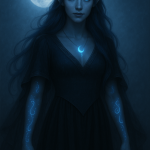
The goddess of Dark: Denday
Appearance
In most surviving depictions, Denday is shown as:
-
A calm, graceful woman wrapped in shades of blue and silver
-
Pale or softly glowing skin touched by moonlight
-
Dark or midnight-blue hair, often veiled or flowing like water
-
Eyes that reflect the blue moon or starlight
Her presence in art is quieter than Quintra’s: softer lines, cooler colours and a sense of stillness, as if she is listening more than she speaks.
Denday in the Fifth Era
By the present day, open worship of Denday is as dangerous as worship of Quintra. Temples that once stood in towns and cities have been destroyed, abandoned or converted to other uses. Most people publicly follow one of the New Faiths, and Denday’s name is rarely spoken aloud.
Her faithful, once proud, became wanderers and outcasts long ago, called night dwellers by those who rule the day. Even so, in the quiet hours beneath the blue moon her blessings are still sought by those who keep faith in gentle darkness and secret hope.
Hidden shrines, small offerings and whispered prayers remain, especially in forests, wild places and remote communities that still remember the night as something more than a thing to fear.
Worship and Temples
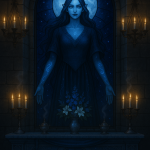
Denday Stained glass Window and Altar
Classical Worship of Denday
In earlier eras, Denday had temples in towns and cities as well as shrines in the wilds.
-
Her worship was strongest at night, especially when the blue moon was visible.
-
Offerings were simple: a cup of clear water, a stone or a blue flower left at hidden shrines, old trees or standing stones.
-
People sought her blessing for safe passage in the dark, protection from unseen dangers, and guidance along paths that could not be walked in daylight.
It is whispered that some healers, wanderers and travellers still know prayers to Denday, asking her to lead them safely through forests or over mountain roads when night falls.
Most villagers, however, keep to the safety of home after sunset, for the night is seen as unpredictable and full of secrets.
Priesthood and Paladins
Like Quintra, Denday once had an organised priesthood and temple guardians.
-
Her priests and priestesses tended moonlit courtyards, kept watch through the night and listened to dreams and confessions.
-
Her paladins guarded her temples, escorted travellers through dangerous regions after dark and defended night dwellers and wild places under her protection.
Where Quintra’s servants stood openly in the light, Denday’s orders often worked more quietly: keeping watch from the shadows and intervening only when needed.
Magic and the Nature of Her Night
Denday is strongly associated with magic of night, shadow and the blue moon.
In common teachings linked to her cult:
-
Night can reveal paths and hidden things that go unseen in the glare of day.
-
Dreams and fears alike feel closer under her light.
-
Her power is subtle, quiet and patient rather than overwhelming.
Children are told that the blue moon’s glow is both a blessing and a warning. The wise show respect to the night, remembering that Denday’s power is different from Quintra’s sun: less about driving things away, more about watching, sheltering and revealing what lies in the dark to those who walk softly.
Myth & History
Dawn and the War with Ghor
In the beginning, the world was shrouded in chaos by Ghor’s hand, and gentle Eonil suffered in darkness. Denday, twin sister to Quintra, travelled across the stars to answer her call.
When the sisters found Eonil, each created a glowing world on opposite sides of the planet: Quintra’s bright golden sun and Denday’s soft blue moon. Together they brought light and darkness to Eonil and fought Ghor.
After centuries of struggle, they defeated Ghor and banished them to a small red moon that would forever circle the world. From then on the three celestial bodies were known by their names: the sun Quintra, the blue moon Denday and the blood moon Ghor.
The Age of Light
For a time after Ghor’s banishment, the twins ruled together. Day and night followed each other in balance: Quintra ruling the day, Denday the night.
But pride and doubt grew. Quintra demanded that all people turn fully to the sun; Denday refused to force her own followers to forsake the moon and the night. Conflict followed between their worshippers. In the end Quintra struck first.
In anger she banished Denday from Eonil’s surface, binding her to the blue moon with such force that half of it went dark. As the wounded moon spun, its changing face created the phases that still mark time today.
Denday’s faithful became wanderers and outcasts. Quintra’s followers hunted them down and drove them into hiding in places where the sun could not reach. The Third Era – the Age of Light began under Quintra’s rule alone.
Banishment and the Age of Darkness
Even bound to her moon, Denday continued to watch the world and bless those who still followed her. The phases of the blue moon remained a constant reminder of what Quintra had done, and Quintra’s own power and influence began to crumble as many refused to abandon Denday completely.
Eventually Quintra herself was banished back into her sun. With both sisters gone from Eonil’s surface, their blessings weakened and the Fourth Era – the Age of Darkness began. Over the following centuries faith in the Old Gods waned and Ghor’s corruption spread through war, plague and the undead.
For Denday’s followers this era meant survival in hiding: scattered night dwellers, secret gatherings under the blue moon and few places left where her name could be spoken freely.
New Faiths and Present Day
Around 55 BFE four new gods appeared: Thoron, Myalanna, Envylon and Ysandra. They founded the New Faiths, declared Quintra, Denday and Ghor “dead” and branded worship of the Old Gods heresy. Conversion was demanded under threat of death.
In the present Fifth Era, the Old Gods are banished to their celestial bodies. All three still have followers and cults, but they are forced into hiding. Followers of Denday — especially night dwellers who openly refuse the New Faiths — are hunted down by the Church, and any talk of her power waxing or waning is frowned upon and dangerous to speak aloud.
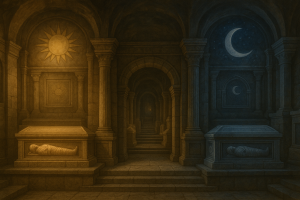
The City of Silence
The dead of Quintra’s and Denday’s temples were not buried like common folk. Instead, their priests and paladins were embalmed and laid to rest in a vast shared necropolis now known as the City of Silence.
-
On Quintra’s side lie the Halls of Radiance: warm stone halls lit by golden light, lined with sarcophagi marked with sun symbols.
-
On Denday’s side lie the Vaults of Midnight: cool blue halls watched over by moons and stars, where the Lady of the Blue Moon is honoured in quiet, eternal night.
Here, light and night still face one another in stone and silence, long after their worship on the surface has been driven into the shadows.
Related articles
0 out of 5 stars
| 5 Stars | 0% | |
| 4 Stars | 0% | |
| 3 Stars | 0% | |
| 2 Stars | 0% | |
| 1 Stars | 0% |