
Search for answers or browse our knowledge base.
Quintra
Quintra
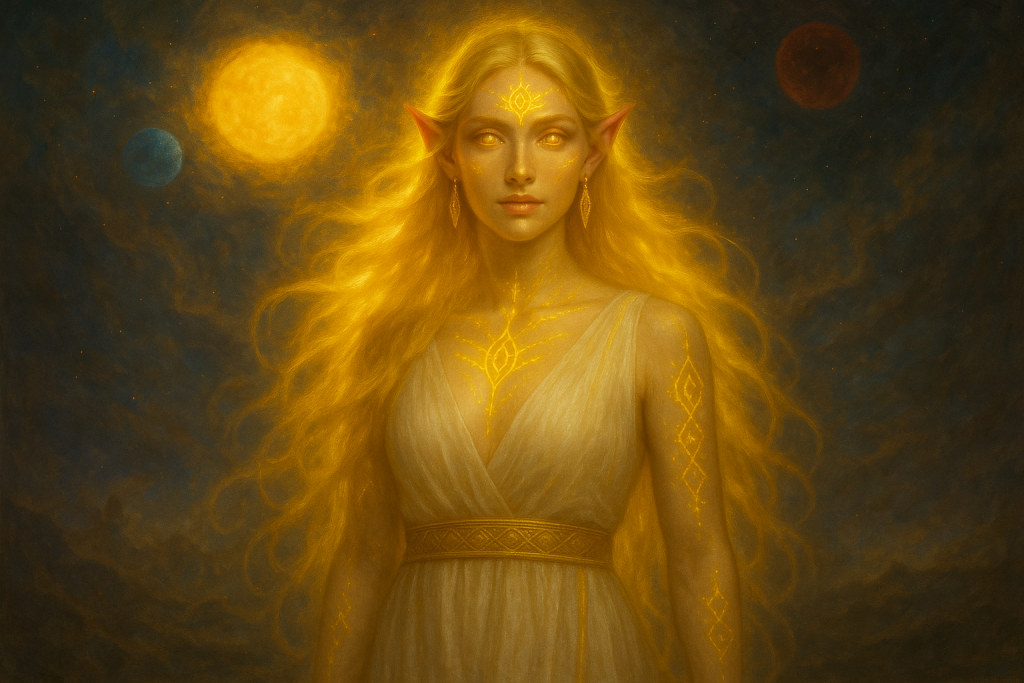
The goddess of Light: Quintra
Lady of Light, Mother of Dawn
“In the light of Quintra, all shadows flee.” — Temple saying
Symbols and Appearance
Symbols
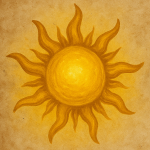
Symbol of Quintra
The most common symbol of Quintra is a golden sun with radiant lines or a simple circle of light. Variants include:
-
Sunbursts carved into stone or armour.
-
Circle-of-light motifs around doors and shrines.
-
Banners bearing a stylized sun over a pale field.
Appearance
In most surviving depictions from temples and manuscripts, Quintra is shown as:
-
A tall, graceful woman with long golden hair
-
Bright golden eyes and light, almost glowing skin
-
Wearing simple white garments with golden trim
-
Sometimes marked with glowing golden patterns along face and arms
This matches the traditional colour palette of her worship: white and cream for purity and clarity, gold for the sun’s light and warmth.
The goddess of Light: Quintra
Quintra in the Fifth Era
By the present day, open worship of Quintra is rare and dangerous. Her temples have been destroyed, repurposed or driven underground, and most people publicly follow one of the New Faiths.
Yet the sun still rises every morning, and many old sayings remain. Some farmers still whisper a quick dawn prayer out of habit. Old families might keep a carved sun tucked away in a chest or hidden niche. In ruins and in the City of Silence, the old symbols of Quintra and Denday still watch over the dead.
Whether Quintra truly is “dead” as the New Faiths claim, or simply waiting beyond the sun, is left to legend and quiet speculation. On the surface, only her light remains.
Worship and Temples
Classical Worship of Quintra
Before her banishment and during the Age of Light, Quintra’s temples could be found wherever people valued safety, healing and order.
-
Worshippers gathered at sunrise (and sometimes sunset) to pray.
-
Candles and lamps were lit, and fragrant oils burned in her honour.
-
Priests and priestesses wore robes of white and gold.
-
Novices were trained in healing arts and in rituals to ward off misfortune.
-
Common offerings included fresh bread, clear spring water, polished stones and wildflowers — traditionally not sunflowers.
Quintra’s priesthood taught that walking in sunlight was to walk under her protection. Night was treated as a time of uncertainty and older, wilder forces, and people were urged to be home before full dark.
Priesthood and Paladins
Quintra’s clergy served as healers, mediators and keepers of order. They blessed contracts and oaths taken in daylight and were often consulted to settle disputes.
Suggested image: Priest of Quintra on the temple steps.
Her militant arm was formed by paladins of Quintra: armoured warriors bearing her sun on shield and breastplate. They guarded temples, escorted pilgrims and stood between danger and those under the Lady of Light’s protection.
Suggested image: Paladin of Quintra shielding civilians.
Magic and the Nature of Her Light
Quintra is strongly associated with light magic. In most teachings linked to her cult:
-
Light reveals truth.
-
Light heals and protects.
-
Light drives away corruption and the creatures of darkness.
In contrast, shadow and night are treated with caution. Shadows are respected, but not trusted, and are often linked to older powers beyond Quintra’s reach.
Myth & History
Dawn and the War with Ghor
At the dawn of time Ghor turned the gentle goddess Eonil into the planet itself and ruled her in chaos and destruction. Quintra and her twin sister Denday wandered the universe in search of Eonil.
When they found her, each created a glowing world on opposite sides of the planet: Quintra’s bright golden sun and Denday’s soft blue moon. Together they brought light and darkness to Eonil and fought Ghor. After a long war they defeated Ghor and banished them to a small red moon that would forever circle the world.
From then on the three celestial bodies were known by their names: the sun Quintra, the blue moon Denday and the blood moon Ghor.
The Age of Light
To decide who was strongest, Quintra and Denday fought an honourable duel. Quintra won and moved her world to the centre, so that Eonil began to circle around her while Denday’s blue world followed on the opposite side. As Eonil turned, day and night were born: Quintra ruling the day, Denday the night.
Over roughly a century Ghor’s whispers turned Quintra against her sister. In anger she banished Denday from Eonil’s surface and bound her to the blue moon with such force that half of it went dark. As the wounded moon spun, its changing face created the phases that still mark time today.
Denday’s followers, the night dwellers, were hunted down by Quintra’s worshippers and forced into the shadows. Quintra’s forces declared victory and the Third Era – the Age of Light began. Under Quintra’s eye Eonil briefly flourished. Trade and travel expanded, and with her permission the Ee’dornil and dragons raised great Waygates across the world.
Banishment and the Age of Darkness
The phases of the blue moon remained a constant reminder of what Quintra had done to her sister. Her power and influence slowly crumbled as many refused to abandon Denday. Even bound to her moon, Denday still managed to bless her followers, and Quintra’s own people began to doubt.
Burdened by guilt, Quintra accepted an invitation from loyal followers of Denday and night dwellers to discuss peace. She ordered her followers to stand down and came alone. The meeting was a trap. They tricked her into revealing the ritual of banishment and used it against her, casting Quintra back into her own sun, just as she had once banished Denday.
With Quintra gone, the Age of Light ended and the Fourth Era – the Age of Darkness began. Over the following centuries her blessings weakened, faith in the Old Gods waned and Ghor’s corruption spread through wars, plagues and the undead.
One of the most feared events of this time was Quintra’s Onslaught: a fanatical host of sun-worshippers who burned towns and villages across what is now the southern Xaverion Islands, leaving only Quintra’s temples standing in their wake before they were finally destroyed. Afterwards, surviving sun-temples were torn down and followers of Quintra were murdered in retaliation.
New Faiths and Present Day
Around 55 BFE four new gods appeared: Thoron, Myalanna, Envylon and Ysandra. They founded the New Faiths, declared Quintra, Denday and Ghor “dead” and branded worship of the Old Gods heresy. Conversion was demanded under threat of death.
In the present Fifth Era, the Old Gods are banished to their celestial bodies. All three still have followers and cults, but they are forced into hiding. Followers of Quintra, even the gentler sun-worshippers, are hunted down by the Church of the New Faiths. Any talk of Quintra or Denday’s power waxing or waning is frowned upon and dangerous if spoken aloud.
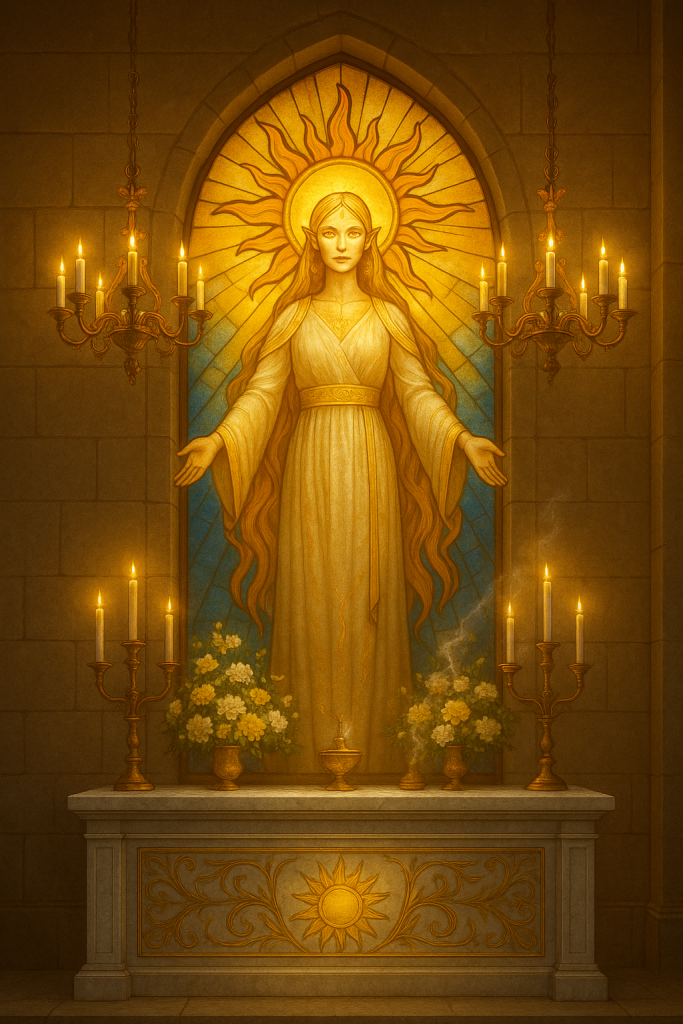
Quintra Glass stained Window and Altar
The City of Silence
The dead of Quintra’s and Denday’s temples were not buried like common folk. Instead, their priests and paladins were embalmed and laid to rest in a vast shared necropolis now known as the City of Silence.
-
On Quintra’s side lie the Halls of Radiance: warm stone halls lit by golden light, lined with sarcophagi marked with sun symbols.
-
On Denday’s side lie the Vaults of Midnight: cool blue halls watched over by moons and stars.
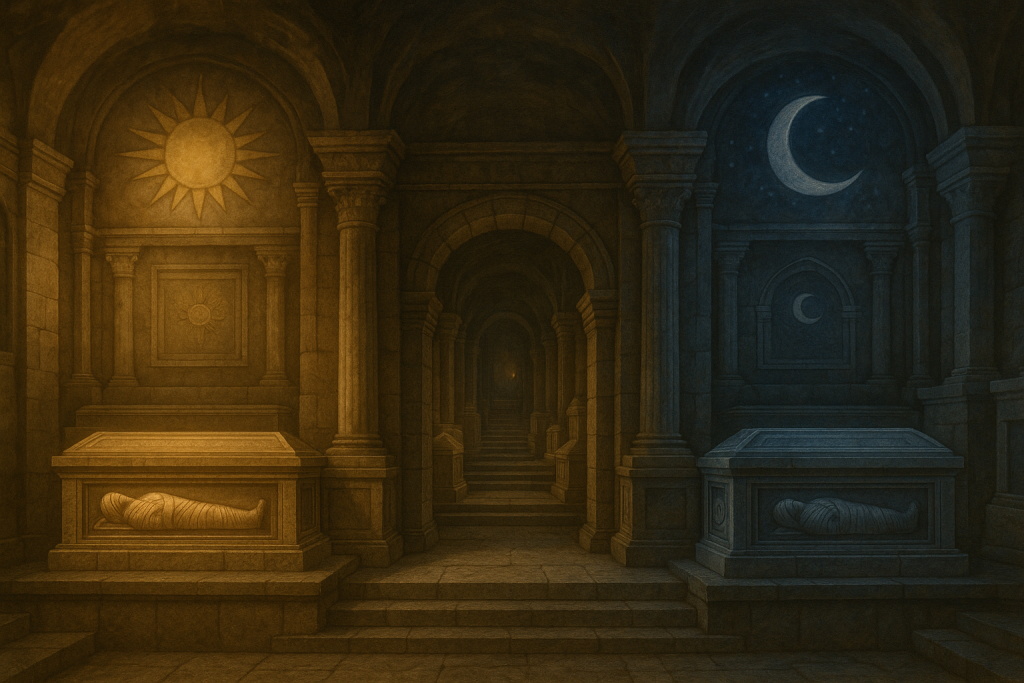
The city of silence